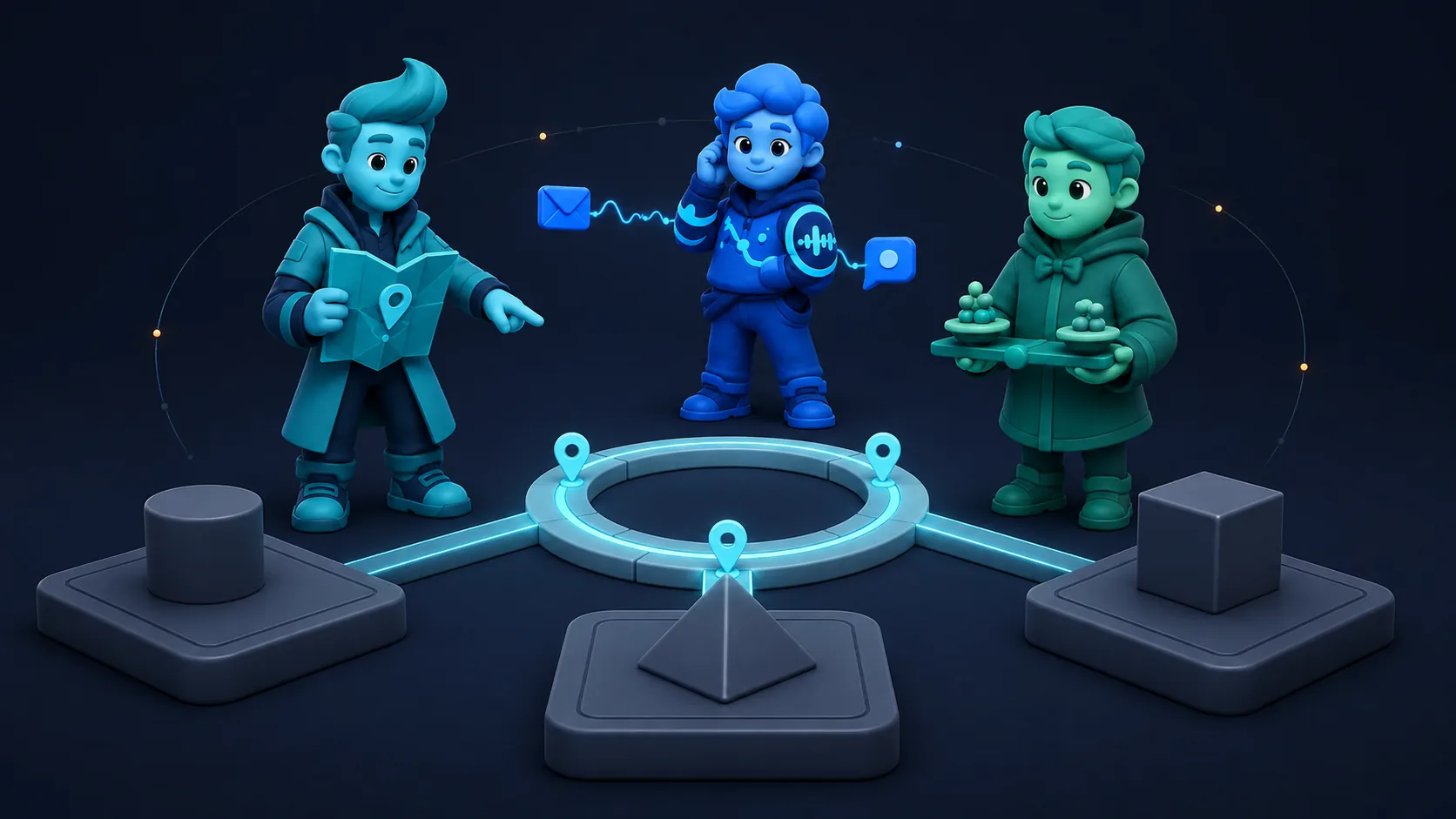
A governed operating system for the company you are building.
Meet the digital workforce that prepares bounded work across leads, customer context, scheduling, communication, research, quality, billing, and owner decisions. Authority stays explicit and every consequential claim remains reviewable.

Choose the first role you want to meet.
The crew is easier to understand when the first moment starts with your business context. Pick a path, inspect the role, and keep the authority boundary visible from the beginning.

Turn a commercial signal into a clear, reviewable next step.
Inspect the crew →Nora + Atlas + LedgerStart with operationsConnect customer context, scheduling, and commercial handoffs.
Inspect the crew →Friday + Chief OperatorStart with owner claritySee what matters now and which handoff needs your authority.
Inspect the crew →Meet the governed workers behind the operation.
Nine original identities make the operating model easier to understand. The image creates recognition; the native detail surface carries responsibilities, boundaries, evidence, and maturity truth.

Recognisable at a glance. Honest on inspection.
Palette and motif help you find the right role. Native copy keeps the promise bounded to what AVC can prove.
Read the visual system ↗Swipe or use the focused rail to explore all 9 roles.
Role indexBrowse all 9 roles+

Chief Operator
Orchestration / delegation / coordination
Keeps work legible across the crew and makes the next governed handoff clear.

Nova
Lead & Sales / growth
Turns commercial signals into structured, reviewable opportunity work.

Nora
Customer Operations
Keeps customer context connected from first request through service follow-up.

Atlas
Scheduling & Dispatch
Makes time, capacity, route, and constraint trade-offs easy to inspect.

Echo
Inbox & Communications
Finds the signal in busy channels and turns messages into clear next steps.

Ledger
Billing & Reconciliation
Keeps commercial handoffs precise, balanced, and tied to attributable work.

Scout
Research & Intelligence
Follows signals to their sources and makes discovery useful to the rest of the crew.

Sentinel
Quality & Compliance
Helps the team verify that a result is supported before it is trusted.

Friday
Owner Copilot
Stays close to the owner, turning system state into a calm strategic next step.

Chief Operator
Orchestration / delegation / coordination
Keeps work legible across the crew and makes the next governed handoff clear.
- Frame the mission
- Coordinate specialist handoffs
- Surface missing authority
- Orchestration
- Delegation
- Coordination
- Allowed tools
- Only the capabilities granted by the active runtime contract.
- Authority boundary
- Coordinates and proposes; it does not create permission.
- Expected outcomes
- Readable next step · Traceable handoff · Owner-visible boundary
- Evidence
- Inspect current mission and evidence surfaces for runtime truth.
- Governing surface
- Operating model ↗
- Current maturity
- Presentation identity approved · runtime status is product-surface specific
Show static state fallbacks+
These poster states are the accessible fallback for future interactive state machines. They describe presentation state, not runtime completion authority.


Nova
Lead & Sales / growth
Turns commercial signals into structured, reviewable opportunity work.
- Capture lead intent
- Structure qualification
- Prepare commercial context
- Lead intake
- Qualification
- Opportunity preparation
- Allowed tools
- Scoped commercial interfaces only; external outreach remains approval-bound.
- Authority boundary
- Prepares before outreach; sending requires the existing approval boundary.
- Expected outcomes
- Clear lead context · Known missing information · Reviewable next action
- Evidence
- Use LeadRescue and evidence surfaces to verify current product maturity.
- Governing surface
- LeadRescue ↗
- Current maturity
- Presentation identity approved · runtime status is product-surface specific
Show static state fallbacks+
These poster states are the accessible fallback for future interactive state machines. They describe presentation state, not runtime completion authority.


Nora
Customer Operations
Keeps customer context connected from first request through service follow-up.
- Maintain customer context
- Prepare service responses
- Surface continuity gaps
- Customer context
- Inbox-to-action preparation
- Service follow-up
- Allowed tools
- Tenant-scoped customer interfaces; no unrestricted external action.
- Authority boundary
- Keeps context connected; consequential actions remain governed.
- Expected outcomes
- Consistent customer context · Fewer dropped handoffs · Reviewable response
- Evidence
- Confirm active capability and evidence state in the relevant platform surface.
- Governing surface
- AVC Products ↗
- Current maturity
- Presentation identity approved · runtime status is product-surface specific
Show static state fallbacks+
These poster states are the accessible fallback for future interactive state machines. They describe presentation state, not runtime completion authority.


Atlas
Scheduling & Dispatch
Makes time, capacity, route, and constraint trade-offs easy to inspect.
- Read scheduling constraints
- Prepare dispatch options
- Expose conflicts
- Scheduling
- Dispatch preparation
- Constraint mapping
- Allowed tools
- Bounded scheduling and dispatch interfaces defined by the active runtime.
- Authority boundary
- Proposes within constraints; it does not silently commit a route.
- Expected outcomes
- Visible trade-offs · Durable job state · Owner-ready proposal
- Evidence
- Verify job state and approval requirements in Mission Control.
- Governing surface
- Mission Control ↗
- Current maturity
- Presentation identity approved · runtime status is product-surface specific
Show static state fallbacks+
These poster states are the accessible fallback for future interactive state machines. They describe presentation state, not runtime completion authority.


Echo
Inbox & Communications
Finds the signal in busy channels and turns messages into clear next steps.
- Structure inbound communication
- Prepare replies
- Keep signal and source together
- Inbox triage
- Communication preparation
- Message context
- Allowed tools
- Scoped inbox and communication interfaces; outbound effect remains explicit.
- Authority boundary
- Drafts and routes communication; it does not imply that a message was sent.
- Expected outcomes
- Clear queue · Attributed message context · Reviewable draft
- Evidence
- Use connector health and message evidence to establish current state.
- Governing surface
- Platform context ↗
- Current maturity
- Presentation identity approved · runtime status is product-surface specific
Show static state fallbacks+
These poster states are the accessible fallback for future interactive state machines. They describe presentation state, not runtime completion authority.


Ledger
Billing & Reconciliation
Keeps commercial handoffs precise, balanced, and tied to attributable work.
- Prepare billing context
- Reconcile work and receipts
- Surface mismatches
- Billing preparation
- Reconciliation
- Receipt matching
- Allowed tools
- Approval-bound billing and evidence interfaces only.
- Authority boundary
- Prepares financial handoffs; it does not create an invoice effect by identity alone.
- Expected outcomes
- Balanced handoff · Known discrepancy · Evidence-linked preparation
- Evidence
- Inspect receipts, billing preparation, and governance state before claiming completion.
- Governing surface
- Evidence ↗
- Current maturity
- Presentation identity approved · runtime status is product-surface specific
Show static state fallbacks+
These poster states are the accessible fallback for future interactive state machines. They describe presentation state, not runtime completion authority.


Scout
Research & Intelligence
Follows signals to their sources and makes discovery useful to the rest of the crew.
- Find relevant sources
- Summarise with provenance
- Surface uncertainty
- Research
- Source mapping
- Signal detection
- Allowed tools
- Research tools within the active capability and source boundary.
- Authority boundary
- Finds and explains evidence; it does not turn an unverified signal into truth.
- Expected outcomes
- Source-backed finding · Known uncertainty · Useful handoff
- Evidence
- Research receipts and freshness remain the source of truth.
- Governing surface
- Research ↗
- Current maturity
- Presentation identity approved · runtime status is product-surface specific
Show static state fallbacks+
These poster states are the accessible fallback for future interactive state machines. They describe presentation state, not runtime completion authority.


Sentinel
Quality & Compliance
Helps the team verify that a result is supported before it is trusted.
- Check required evidence
- Surface policy gaps
- Make quality reviewable
- Quality checks
- Compliance review
- Evidence verification
- Allowed tools
- Review and verification interfaces; no authority to rewrite policy by identity alone.
- Authority boundary
- Verifies and flags; it does not grant approval or become a police role.
- Expected outcomes
- Reviewable result · Visible gap · Traceable verification
- Evidence
- Verification receipts and policy state are authoritative.
- Governing surface
- Governance ↗
- Current maturity
- Presentation identity approved · runtime status is product-surface specific
Show static state fallbacks+
These poster states are the accessible fallback for future interactive state machines. They describe presentation state, not runtime completion authority.


Friday
Owner Copilot
Stays close to the owner, turning system state into a calm strategic next step.
- Explain what matters now
- Prepare owner decisions
- Keep context human-near
- Owner briefing
- Decision preparation
- Strategic context
- Allowed tools
- Owner-scoped interfaces explicitly available to the active product surface.
- Authority boundary
- Advises the owner; it is not the orchestration authority and cannot approve itself.
- Expected outcomes
- Clear briefing · Decision-ready context · Human-owned next action
- Evidence
- Current mission, evidence, and approval state must be inspected in the platform.
- Governing surface
- Owner governance ↗
- Current maturity
- Presentation identity approved · runtime status is product-surface specific
Show static state fallbacks+
These poster states are the accessible fallback for future interactive state machines. They describe presentation state, not runtime completion authority.


Character identity is presentation. Permission, capability, mission state, and completion evidence remain owned by AVC contracts and runtime surfaces.
One operating model. Every relationship visible.
Owner, Friday, Chief Operator, workforce, products, missions, evidence, verification, and outcomes form one connected model. The map explains authority and context; it never replaces the contracts that govern execution.
Directional cues: Friday → Owner · Chief Operator → Workforce · Missions → Evidence · Verification → Outcomes
Owner
Human ownership, approval, and consequential decisions remain outside the presentation layer.
Root authorityFriday
Faces the owner, explains what matters, and prepares decision-ready context.
Advises; cannot approve itselfChief Operator
Coordinates inward across the system and delegates bounded work without creating permission.
Coordinates; cannot create authorityWorkforce
Presentation identities make responsibilities legible; contracts and evidence govern execution.
Identity ≠ permissionProducts
LeadRescue: Pilot validation · implementation present · not production-approved · Mission Control: Scaffolded · owner-visible read model · ServiceOps: Shadow slice · proposal-first
Presence ≠ production approvalMissions
A mission names the next governed handoff, scope, and owner checkpoint.
Scope before actionEvidence
Evidence stages: Intent → Bounded work → Action → Evidence → Verification → Outcome.
Illustration ≠ live receiptVerification
Verification checks the evidence and verification stages; mismatch fails closed.
Fail closedOutcomes
An outcome is a reviewable result, not proof that a production side effect occurred.
Outcome ≠ silent commitmentPlatform
Authority, contracts, connectors, mission state, and evidence remain governed by platform surfaces.
System of record stays authoritativeConnectors
Connector health, scopes, actions, evidence, and revocation stay explicit at the system boundary.
Credentials and writes remain gatedRelationship ledger
The same relationships are available as native links and structured list content. Position, line, color, and motion are explanatory enhancements only.
Friday turns current system context into an owner-visible decision surface.
Advises; cannot approve itself · Root authorityFriday prepares context but cannot approve itself or become orchestration authority.
Advises; cannot approve itself · Root authorityChief Operator makes bounded handoffs legible across the nine canonical workers.
Coordinates; cannot create authority · Identity ≠ permissionWorkers appear in product contexts without gaining permission from presentation identity.
Identity ≠ permission · Presence ≠ production approvalProduct worlds frame bounded work such as commercial recovery or a scheduling proposal.
Presence ≠ production approval · Scope before actionA mission can prepare the next step; consequential approval remains human-owned.
Scope before action · Root authorityPrepared work must leave an attributable trail before its result can be trusted.
Scope before action · Illustration ≠ live receiptVerification checks authority, source, and receipt alignment; mismatch fails closed.
Fail closed · Illustration ≠ live receiptOnly a verified, reviewable result can be presented as an outcome.
Fail closed · Outcome ≠ silent commitmentConnectors expose scoped interfaces; they do not hand agents keys or create authority.
System of record stays authoritative · Credentials and writes remain gatedPlatform contracts and runtime surfaces remain the authority for current evidence state.
System of record stays authoritative · Illustration ≠ live receipt
Explore the operating model
On smaller screens, relationships become a readable sequence rather than a compressed diagram.
Follow a concrete path
Nova → LeadRescue
Commercial intent becomes bounded mission work, evidence, verification, and a reviewable outcome.
Inspect evidence relationship →Atlas → ServiceOps
A scheduling proposal remains bounded by constraints, approval, and evidence before an owner decision.
Inspect approval boundary →Sentinel → verification → evidence
A mismatch is not success: missing authority or evidence mismatch stops the chain and requires repair and re-verification.
Inspect recovery path →Detail paths
- Chief OperatorOrchestration / delegation / coordination
- NovaLead & Sales / growth
- NoraCustomer Operations
- AtlasScheduling & Dispatch
- EchoInbox & Communications
- LedgerBilling & Reconciliation
- ScoutResearch & Intelligence
- SentinelQuality & Compliance
- FridayOwner Copilot
Presentation identity ≠ runtime identity. A worker relationship explains context; it does not grant permission.
From signal to proof — with the owner in the loop.
The same crew can appear across growth, ServiceOps, and platform trust surfaces. These are product patterns, not a promise that every handoff is active in every tenant.
- 01
Turn a signal into a customer-ready next step
Owner checkpointNova frames the commercial signal. Nora preserves customer context. Chief Operator coordinates the bounded next move while Friday keeps the owner's decision visible.
Boundary · A proposal can be prepared without silently committing the company.
Meet the growth path → - 02
Turn a request into a scheduled operation
Needs inputNora captures intent. Atlas shapes a route and timing proposal. Echo prepares the communication path that keeps the customer and team aligned.
Boundary · Missing availability, access, or policy pauses the handoff instead of being guessed.
Meet the operations path → - 03
Turn delivery into proof
Evidence readySentinel checks quality and compliance evidence. Ledger reconciles the commercial record. Friday helps the owner decide what should happen next.
Boundary · Worker artwork never grants approval; contracts, evidence, and authority do.
Meet the trust path →
- DelegatedA named role receives the bounded next step.
- Needs inputMissing context or authority stops the chain.
- Evidence readyThe outcome has a receipt the owner can inspect.

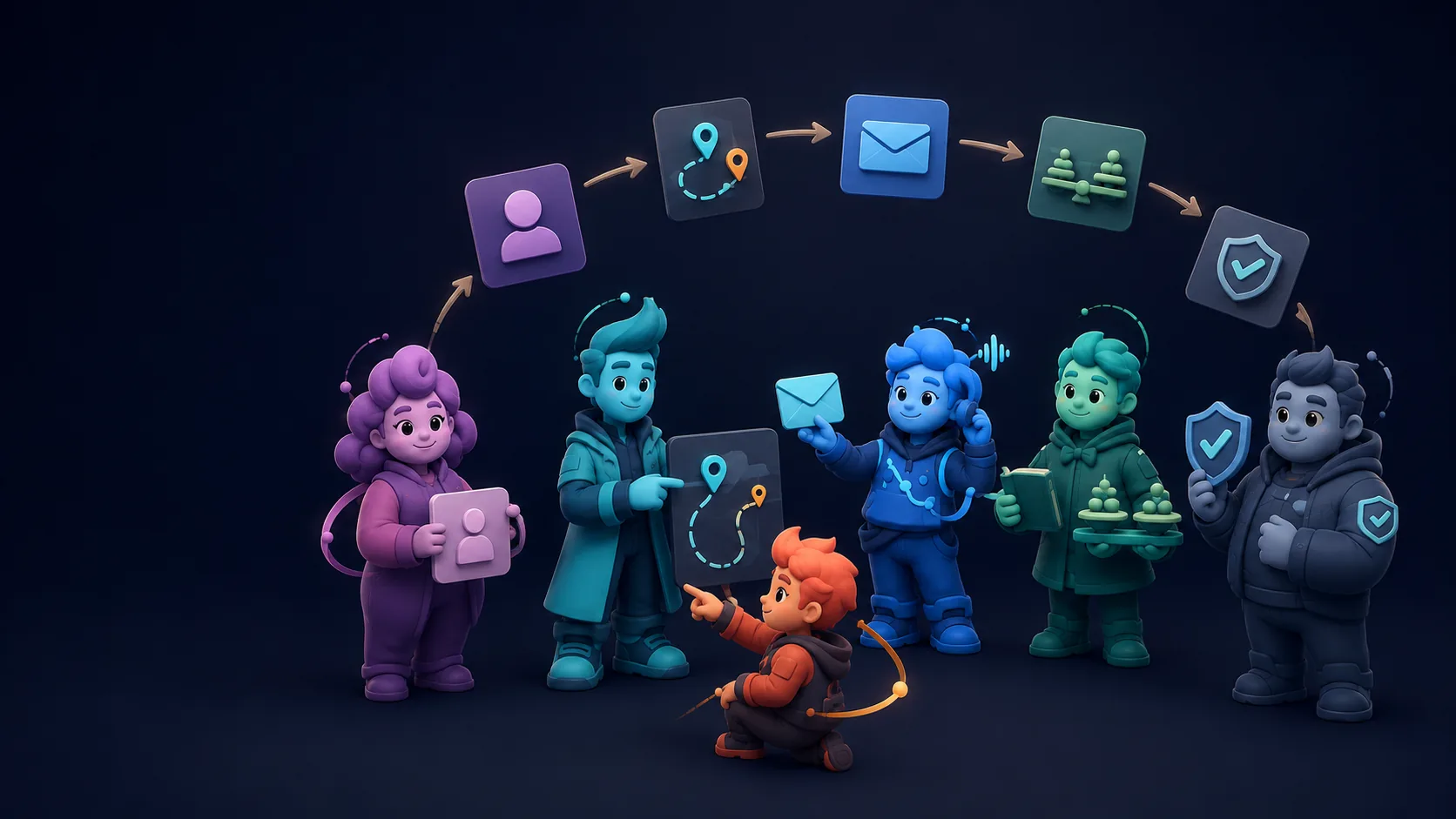
Delegation should look like a handoff, not a magic trick.
A shared mission moves between named roles. Each transition can carry context, authority, and evidence without pretending that a character illustration is the runtime.
- 01Nova · Qualify
Commercial intent becomes reviewable context.
- 02Chief Operator · Delegate
The mission routes work to the right role.
- 03Atlas · Coordinate
Constraints become a bounded schedule proposal.
- 04Sentinel · Verify
Quality and evidence remain visible before trust.
- 05Ledger · Reconcile
Work and receipts meet at a governed handoff.

A shared context layer the crew can explain.
Business Brain is useful when context has a source, freshness, tenant scope, and authority. The visual shows relationships; the platform shows what can actually be trusted.
Context can point back to a file, link, or connected system.
A context item can be reviewed against its last-known update.
Workspace and tenant boundaries stay visible as the crew works.
Shared context informs a job; it never grants permission.

Connect systems without handing agents the keys.
A connector is an operational boundary: credentials, scopes, actions, health, retries, evidence, and revocation stay explicit. Each entry below is a governed interface category; provider enablement remains product- and tenant-specific.
Inbound + outbound boundary
Availability + booking state
Business context + evidence
Invoice preparation + receipts
Reconciliation signals
Product and operator capabilities

Connector availability is product- and tenant-specific. Public examples describe governed interface categories, not a claim that every external provider is production-enabled.
ServiceOps turns the crew into business operations.
Leads, customer context, scheduling, delivery, quality, communication, and billing can share an operating language while every transition stays bounded by the platform.

The same workforce enters different operating worlds.
Product identity, maturity, authority, and evidence stay visible together. The illustration can explain the system without upgrading a pilot, scaffold, or shadow slice into a production claim.
Recover commercial intent before it disappears.
Lead response, qualification, follow-up, and booking preparation form a bounded commercial loop without pretending that provider integrations are already production-active.
- Authority
- Prepare and review only. External communication and production operation remain gated.
- Evidence
- Qualification state · communication records · approval boundary
Keep the owner close to the consequential moment.
Mission Control presents missions, approvals, evidence, incidents, and products as an owner-facing operating surface without replacing the underlying systems of record.
- Authority
- Observe and surface owner controls. The presentation layer does not grant execution authority.
- Evidence
- Jobs · events · incidents · approval state
Turn customer work into a governed operating flow.
Tenant-scoped customer context, booking, scheduling, job readiness, verification, and reconciliation can share one operating language while external effects stay bounded.
- Authority
- Provider writes remain gated behind scope, OAuth, and approval boundaries.
- Evidence
- Tenant-scoped records · proposal references · recovery evidence
A claim should travel farther than the agent that made it.
AVC separates intent, bounded work, action, evidence, verification, and outcome so a public illustration never has to impersonate runtime truth.
- 01FramingIntent
What outcome is requested?
- 02AuthorityBounded work
Who may act, and under which scope?
- 03ExecutionAction
What was attempted or prepared?
- 04ProvenanceEvidence
Which source or receipt supports the claim?
- 05TrustVerification
What check passed, failed, or needs repair?
- 06ResultOutcome
What changed for the customer, business, or owner?
Prepared next step
- Mission
- LeadRescue handoff example
- Workers
- Nova → Chief Operator
- Authority
- Review required before external effect
- Evidence
- Qualification + source context
- Verification
- Illustration only · no runtime completion claim
- Outcome
- Reviewable next action
- Owner state
- Decision remains human
Recovery is part of the proof chain.
When authority or evidence is missing, AVC should stop, explain the break, and expose the next reviewable step instead of smoothing failure into a success state.
- Missing authority→Blocked→Owner decision required
- Evidence mismatch→Repair proposed→Reverify before trust
Warm workers. Serious system truth.
On governance, evidence, approvals, architecture, and security surfaces, the crew steps back. Small actor indicators identify who is involved while native AVC contracts carry the decision.

Autonomy that can explain itself.

Start with the crew. Inspect the boundaries. Enter the protected platform through the governed identity boundary.